

Independent bodies in professional football: a comparison between Italy and England
The recent new edition of the FIGC Internal Organizational Rules (“NOIF”) and the publication of the National Licensing System (“SLN”) for the 2026–27 sporting season have formally confirmed the entry of the Commissione Indipendente per la verifica dell’equilibrio economico e finanziario delle società sportive professionistiche (the “Independent Commission”) into the Italian football control system.
The Independent Commission was established by Article 13-bis of Legislative Decree No. 36 of 28 February 2021 and has been operational since 1 October 2025. It is composed of seven members, five appointed members and two permanent members: the Director General of the Italian Revenue Agency and the President of INPS. The Independent Commission has replaced Co.Vi.So.C., the former control body which was part of the FIGC.
The explanatory report accompanying the relevant decree-law states that the establishment of the Independent Commission “responds to the urgent need to reorganize the regulatory framework governing financial controls over professional sports clubs, not only to ensure the proper conduct of sporting competitions, but also to guarantee clubs’ admission to such competitions. This urgency arises from the fact that, following the Paris 2024 Olympic Games, sports governing bodies will be called upon to renew their leadership positions and, in this context, it is necessary to intervene promptly to ensure that the body responsible for supervising professional clubs and issuing opinions on their admission to competitions is independent and remains external to the Federal Council.”
The need for an independent supervisory body in professional football is not unique to Italy, but has also been strongly felt in England. This need led to the establishment of the Independent Football Regulator (“IFR”).
Given that both bodies have been recently established, it is reasonable to assume that they will undergo a settling-in period during which: (i) their activities and interactions with other sectoral and non-sectoral institutions will be defined in greater detail, and (ii) operational practices will be consolidated. Against this background, it is already possible to outline an initial comparison between the main features of the two entities (*).
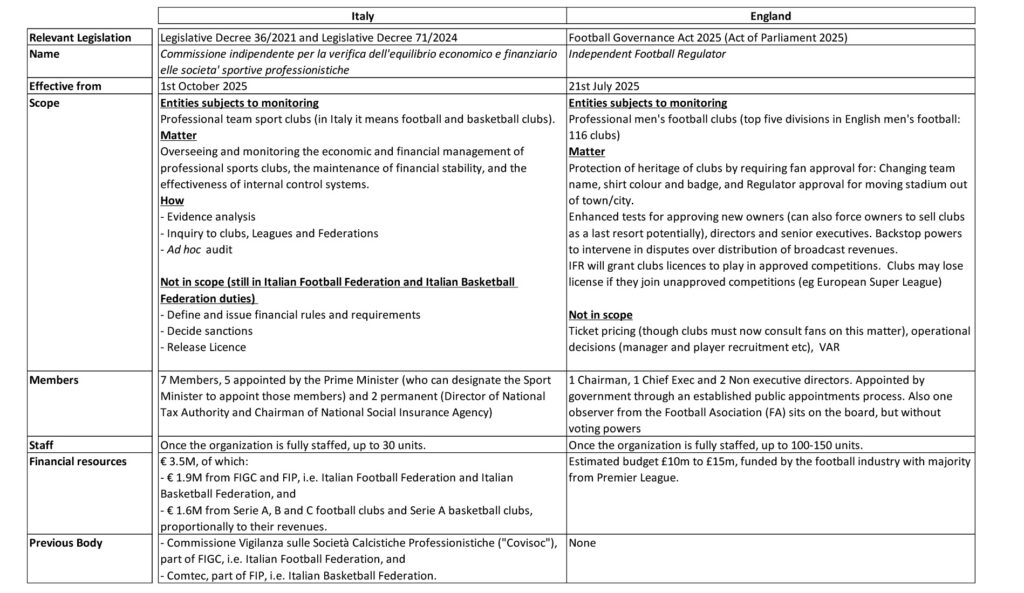
Without implying any value judgment, the following factual considerations may be drawn from the above comparison:
- the scope of activity of the English body is broader than that of the Italian one and, accordingly, it requires greater resources for its operation, both in terms of staff and financial means;
- the activities of the English body also include oversight of club ownership structures;
- the responsibilities of the IFR also encompass the design of the financial rules and compliance requirements applicable to professional clubs, whereas in Italy this function remains within the remit of the relevant sectoral bodies.
The first task for the Independent Football Regulator in England is to take on responsibility for operating the new Owners, Directors and Senior Executives approval regime in May 2026, and the deadline for clubs to submit their applications for operating licenses from the Regulator for the 2027/28 season is expected to be in November 2026.
The first occasion on which the Independent Commission and the new control framework in Italy will be called upon to pursue the primary objective for which they were established will be, in the coming spring, the process for the allocation of the National Licence for the 2026/27 sporting season, which is decisive for clubs’ admission to the upcoming competitions.
(*) With reference to the IFR, we would like to express our sincere thanks to Kieran Maguire, football finance expert and Lecturer at the University of Liverpool Management School, Bart Huby, Partner – Head of Sport Analytics and Advisory practice at LCP, and Aaryaman Banerji, Head of Football Governance at LCP, for the insightful dialogue and the valuable information provided.